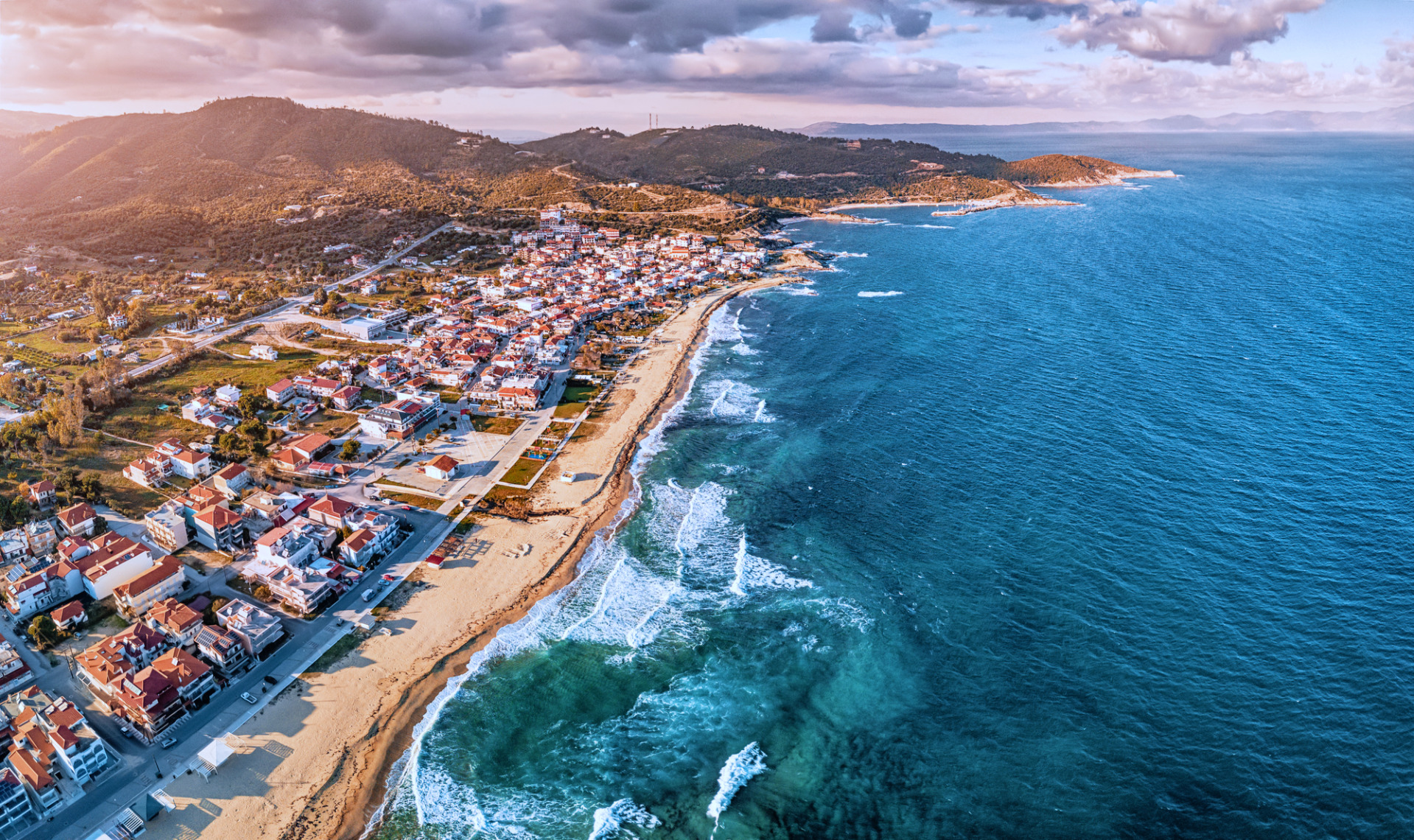
Sarti's beach gets the photographs, but the village behind it is the reason people come back year after year. Away from the sand there is a working Greek community with its own daily rhythm: bakery queues at eight, old men solving the world's problems over coffee at ten, shutters closed against the afternoon heat, and the whole village out walking at dusk. Learn to read that rhythm and your holiday changes texture entirely. This is a guide to Sarti off the sand, and to being the kind of visitor a working village is glad to host.
Morning: Bread, Coffee and the Market Rhythm
Sarti wakes early, long before the beach does. Bakeries fire up before dawn, and by eight the village smells of bread, sesame and warm butter pastry. Join the queue: point at what looks good, learn the words for one of those, and carry your paper bag to a bench like everyone else. Fresh bread, a slab of tiropita or a koulouri ring is the real local breakfast, and our traditional Greek breakfast guide explains the full cast of morning pastries worth knowing.
Mornings are also when the village restocks. Delivery trucks squeeze down the narrow streets, mini-markets pile crates of peaches and tomatoes outside their doors, and in summer the produce is aggressively seasonal: whatever the region grew that week, in quantity, at its best. Shop the way locals do, buying for a day or two at a time, and you will eat better than any all-inclusive buffet can manage.
Kafeneio Culture: Coffee as an Institution
Every Greek village has its kafeneio, the traditional coffee house, and the pattern holds in Sarti: somewhere near the centre of village life there are tables where the same men have occupied the same chairs for decades, nursing a single coffee for two hours while discussing football, politics and the sea. A kafeneio is not a cafe in the tourist sense; it is a social institution, and sitting in one, even as an obvious outsider, is a small act of participation.
Order a Greek coffee and specify the sugar when you order: sketos is unsweetened, metrios medium, glykos sweet. It arrives small, strong and with a glass of water, and the grounds stay in the cup, so stop sipping before the bottom. Nobody will hurry you; the entire point is that the coffee is an excuse for the sitting. The full etiquette, history and vocabulary live in our Greek coffee culture guide, and a few words of Greek from our language basics for travellers will earn you warmer smiles than any tip.
The Church and the Square
The village church anchors Sarti the way churches anchor every Greek community: geographically, socially and audibly, since its bell marks time and summons the faithful on Sunday mornings and feast days. Visitors are welcome to look inside outside of services if the door is open; dress modestly, with shoulders covered and no beachwear, speak softly, and ask before photographing anything or anyone. If you are around for a saint's day or a summer feast, you may find the village at its most itself: services first, then food, music and dancing that runs late.
The square and the streets around the church work as the village living room. Children play there in the evening while parents talk, notices for local events get posted nearby, and during celebrations it becomes the stage. Sit at its edge with a drink and watch: it is better than television.
Evening: The Volta and the Returning Boats
As the heat breaks, Sarti performs the most Greek of rituals: the volta, the evening stroll. Families dress a notch better than the beach, ice creams appear, and the main street and seafront fill with people walking slowly up, then slowly back, greeting everyone they know, which is everyone. Join it. There is no destination; the walking is the point, and it is the easiest way to feel part of the village rather than a spectator of it.
Down at the water, small fishing boats still work out of Sarti and the coves around it, and their comings and goings set another clock. Nets get mended and stacked, boxes are hosed down, and the day's catch takes the shortest possible route to village kitchens: what swam that morning is on taverna tables by evening. If the boats and their rituals catch your imagination, our guide to Greek fishing culture in Halkidiki goes deep on a way of life that long predates tourism on this coast.
The Shoulder Season: Sarti at Half Volume
Come in May, early June, late September or October and you meet a different village. The crowds are gone, the sea is still warm well into autumn, and Sarti reverts to something closer to its winter self: slower, quieter, more personal. Shopkeepers have time to talk, tavernas that stay open cook for neighbours as much as for visitors, and the volta shrinks to a friendly hum. Mornings smell of rain on pine instead of sunscreen.
This is the best version of village life for travellers who want it, with one honest caveat: not everything stays open, and the village runs on reduced hours. That trade is worth it. Our shoulder-season guide to Halkidiki covers timing, weather and what to expect month by month.
How to Be a Good Guest in a Working Village
Sarti hosts thousands of visitors, but it is a home first. The code is short and mostly obvious:
- Dress for context: swimwear belongs on the beach. Put on a shirt for the supermarket, the bakery and certainly the church.
- Respect the afternoon quiet: roughly from after lunch until late afternoon, the village rests, especially in summer. Keep noise down in residential streets.
- Learn five words: kalimera, kalispera, efharisto, parakalo, yamas. They transform interactions.
- Spend where it stays: family bakeries, village shops, local producers. Money spent in the village keeps the village alive in winter.
- Ask before photographing people, including fishermen at work; most say yes, and the asking is the courtesy.
- Drive like a guest: narrow streets, children, cats and delivery trucks all share the same tarmac.
None of this is difficult, and the return on it is real: villages remember good guests, and by your second visit you will be greeted like one.
Lauer House belongs to exactly this fabric: a family-run taverna in the village, open daily from 10:00 to 24:00 in season, cooking fresh seafood and traditional Greek dishes, with a slow-braised goat shank that is our answer to the question of what to eat after the volta. You can read more about who we are on our story page, browse the menu at menu.lauerhouse.gr, and on Wednesday and Thursday evenings from 20:00 the live Greek music gives the village one more reason to stay out late. Come find us; the table is part of village life too.