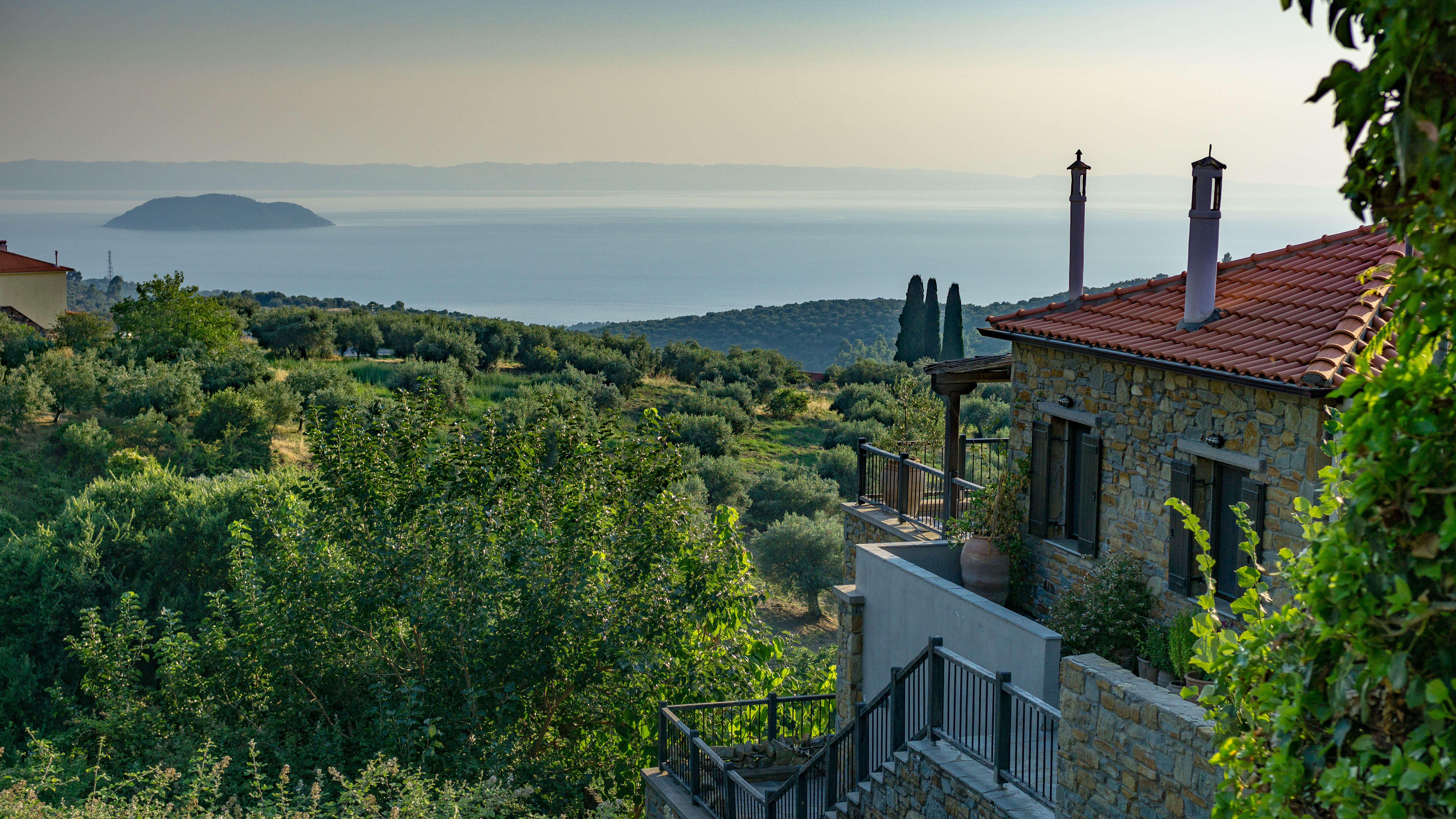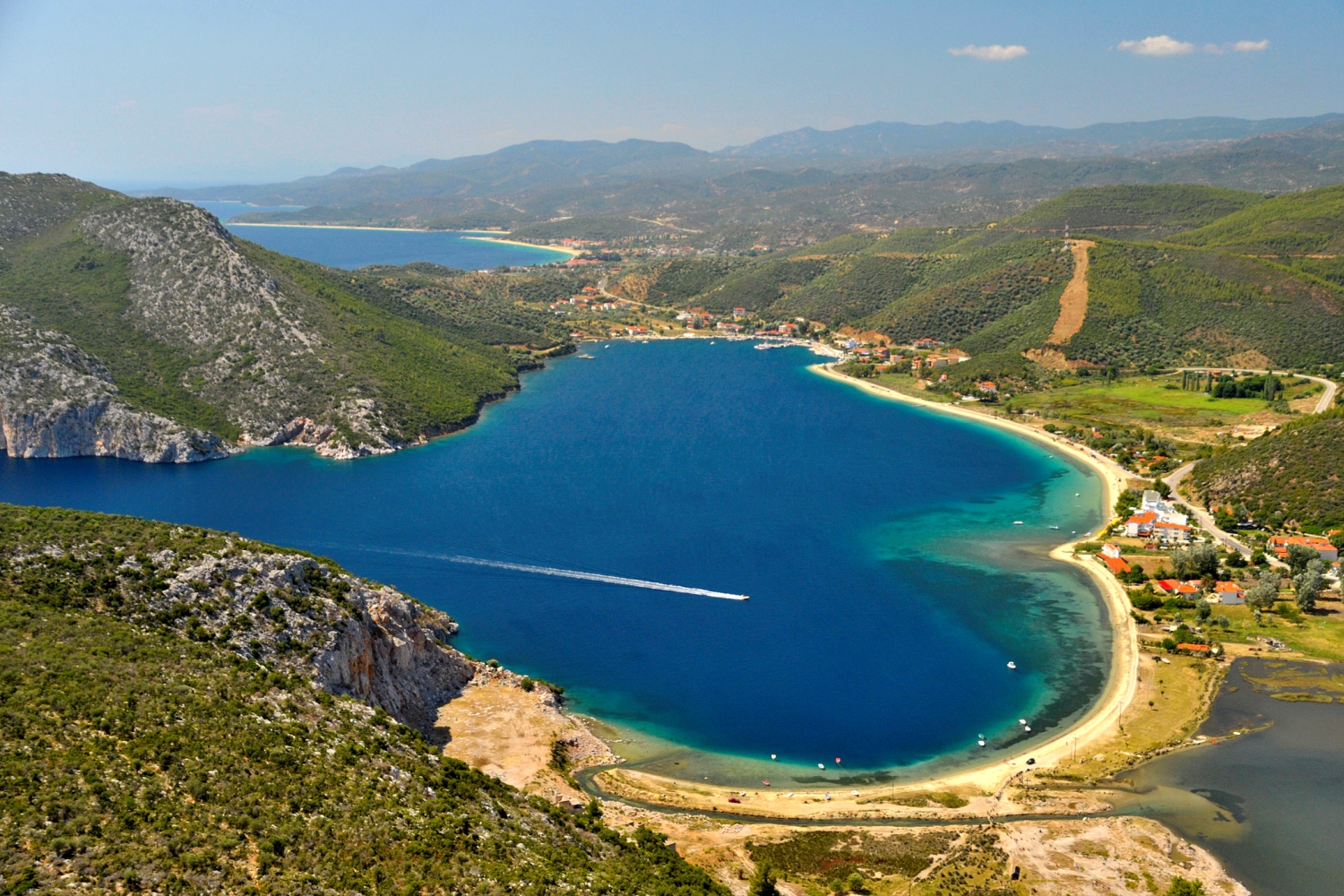
Most visitors come to Halkidiki for the beaches, and fair enough - but the ground beneath those beaches has stories worth knowing. This is where mythology placed the great battle between gods and giants, where a philosopher who shaped Western thought was born, where Athenian and Macedonian armies decided the fate of city-states, and where a thousand-year-old monastic republic still keeps Byzantine time. Knowing even a little of this history changes how the peninsulas look: a headland becomes a buried giant, a pile of stones becomes a classroom, a distant mountain becomes a living museum. Here is Halkidiki in myth and history, from the age of giants to the age of monks.
When Giants Fell: The Gigantomachy on Kassandra
In Greek myth, the gigantomachy - the cataclysmic war between the Olympian gods and the Giants - was fought at Pallene, the ancient name for the westernmost peninsula we now call Kassandra. Here, legend says, the earth-born Giants stormed Olympus and were beaten down one by one, and the mightiest of them were not killed but buried alive beneath the landscape. Local tradition holds that Enceladus, greatest of the Giants, lies pinned beneath Kassandra itself: earthquakes are his struggling, and the hot springs that seep from the peninsula's rock are said to be his fiery breath still escaping. It is hard to find a better creation myth for a landscape of restless seismic warmth.
The easternmost peninsula has its own giant. One version of the tale says Athos hurled a colossal rock at Poseidon during the battle, and it fell into the Aegean to become the mountain that bears his name; another says Poseidon buried the defeated giant beneath it. Either way, the myth-makers were doing what they always did - explaining a landscape too dramatic to be accidental. Our Kassandra guide covers the modern peninsula sitting atop its sleeping giant.
Sithon, Pallene and the Naming of the Peninsulas
The middle peninsula carries the name of a mythical king: Sithon, remembered as a ruler in these northern lands, gave Sithonia its name. Myth links him to his daughter Pallene, a princess so sought-after that Sithon forced her suitors to fight for her hand - and Pallene, favouring one of them, tipped the contest in his favour. Her name attached to the western peninsula, which the ancient world knew as Pallene for centuries before history renamed it.
That renaming is itself a story. After Alexander the Great's death, his general Cassander rose to rule Macedon; around 316 BC he founded the city of Cassandreia near ruined Potidaea on Pallene, and in time the whole peninsula took his name - Kassandra. Cassander also founded a city on the Thermaic Gulf and named it after his wife, Alexander's half-sister Thessaloniki: the metropolis of northern Greece still bears her name today. So the region's map reads like a family tree of myth and Macedonian dynasty at once - a king of legend on one peninsula, a king of history on the other, and on the third a mountain named for a fallen giant. For today's traveller-friendly version of Sithon's kingdom, see our complete Sithonia guide.
Aristotle of Stagira: Halkidiki's Greatest Mind
In 384 BC, in the small coastal city of Stagira on Halkidiki's northeastern shore, was born arguably the most influential thinker in Western history. Aristotle - student of Plato, founder of the Lyceum in Athens, and the man who effectively invented formal logic, biology and literary criticism - spent his boyhood on this coast before philosophy carried him away. His most consequential appointment brought the region full circle: King Philip II of Macedon hired him as tutor to his teenage son, the future Alexander the Great. The mind that would conquer the known world was trained by a boy from Halkidiki.
You can visit both his cities. The ruins of ancient Stagira occupy a gorgeous pine-covered headland by the fishing village of Olympiada - walls, foundations and sea views that make the site worth the trip on scenery alone. In the hilltop village of modern Stagira, a landscaped park honours the philosopher with large-scale interactive instruments demonstrating the physical phenomena he studied, a favourite with children. Both fit neatly into a drive up the east coast; our guide to day trips from Sarti sketches the route.
Ancient Cities: Olynthos, Toroni and Potidaea
Halkidiki's classical history is a story of prosperous colonies caught between great powers. Olynthos, inland between the two western peninsulas, grew into the head of the Chalcidic League and one of the most important cities in the north - until it defied Philip II of Macedon, who razed it utterly in 348 BC and enslaved its people. The catastrophe froze the city in time, and excavation has made it an archaeological treasure: a planned grid of streets and houses whose pebble mosaics are among the earliest floor mosaics known in Greece. Walking its quiet plateau today is the closest Halkidiki comes to time travel.
Toroni, near Sithonia's southwestern tip, was founded by Greek colonists in the deep past and became a significant power with its own coinage, fought over during the Peloponnesian War. Fortification ruins still stand on the Lecythus promontory beside a superb beach, and neighbouring Porto Koufo - a bay so enclosed the ancients remarked on it - remains one of the finest natural harbours in Greece. Potidaea, at the neck of Kassandra, was a Corinthian colony whose revolt in 432 BC helped ignite the Peloponnesian War itself; today a canal cuts the isthmus where its walls once stood.
Byzantine Towers and the Medieval Coastline
Drive the coasts with an eye out and you will keep spotting them: solitary stone towers standing over harbours and headlands. These are Halkidiki's Byzantine signature. Through the Middle Ages, much of the peninsula belonged to the monasteries of Mount Athos as agricultural estates called metochia, and the towers were built to watch over them - part granary, part refuge, part lookout against the pirates who plagued the Aegean. The best known is the Prosforios Tower at Ouranoupoli, standing photogenically at the gateway to Athos; another fine example dominates the little harbour of Nea Fokea on Kassandra.
The towers are a reminder that Halkidiki's medieval history was written largely by monks and raiders - and one earlier empire-builder left a mark here too. In the 480s BC, before invading Greece, the Persian king Xerxes ordered a canal dug clean across the neck of the Athos peninsula so his fleet could avoid rounding the cape where a previous Persian armada had been wrecked in a storm. The Xerxes Canal silted up long ago, but its shallow depression can still be traced across the isthmus - one of antiquity's great engineering feats, hiding in plain sight beside a holiday road.
Mount Athos: A Living Fragment of Byzantium
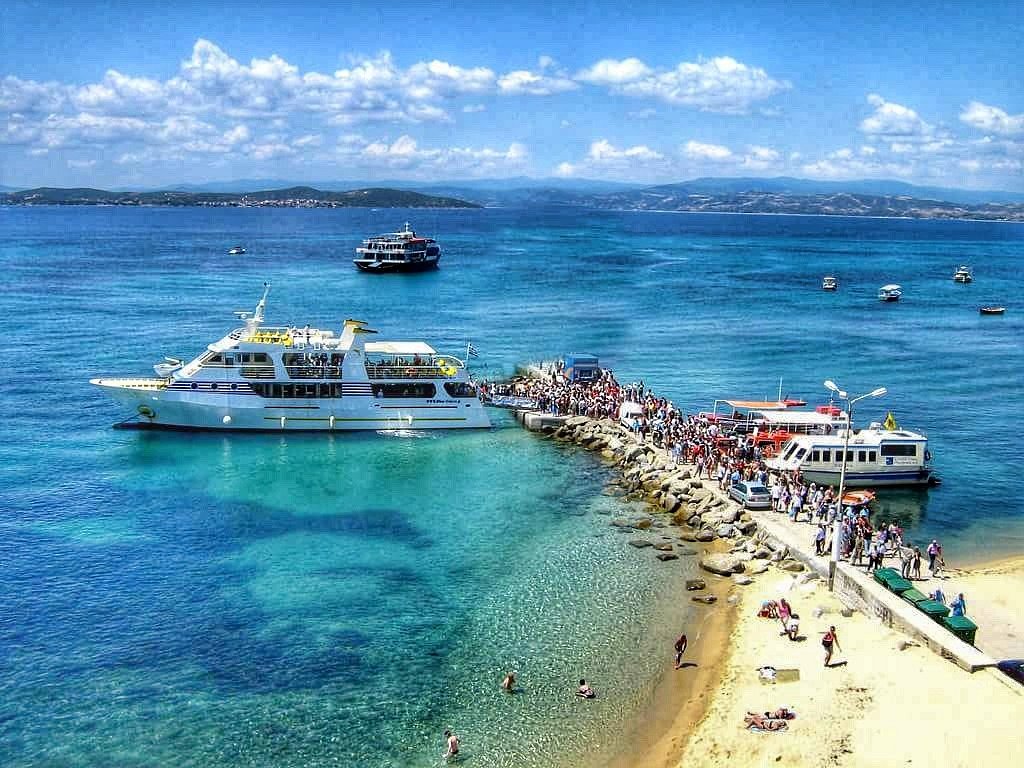
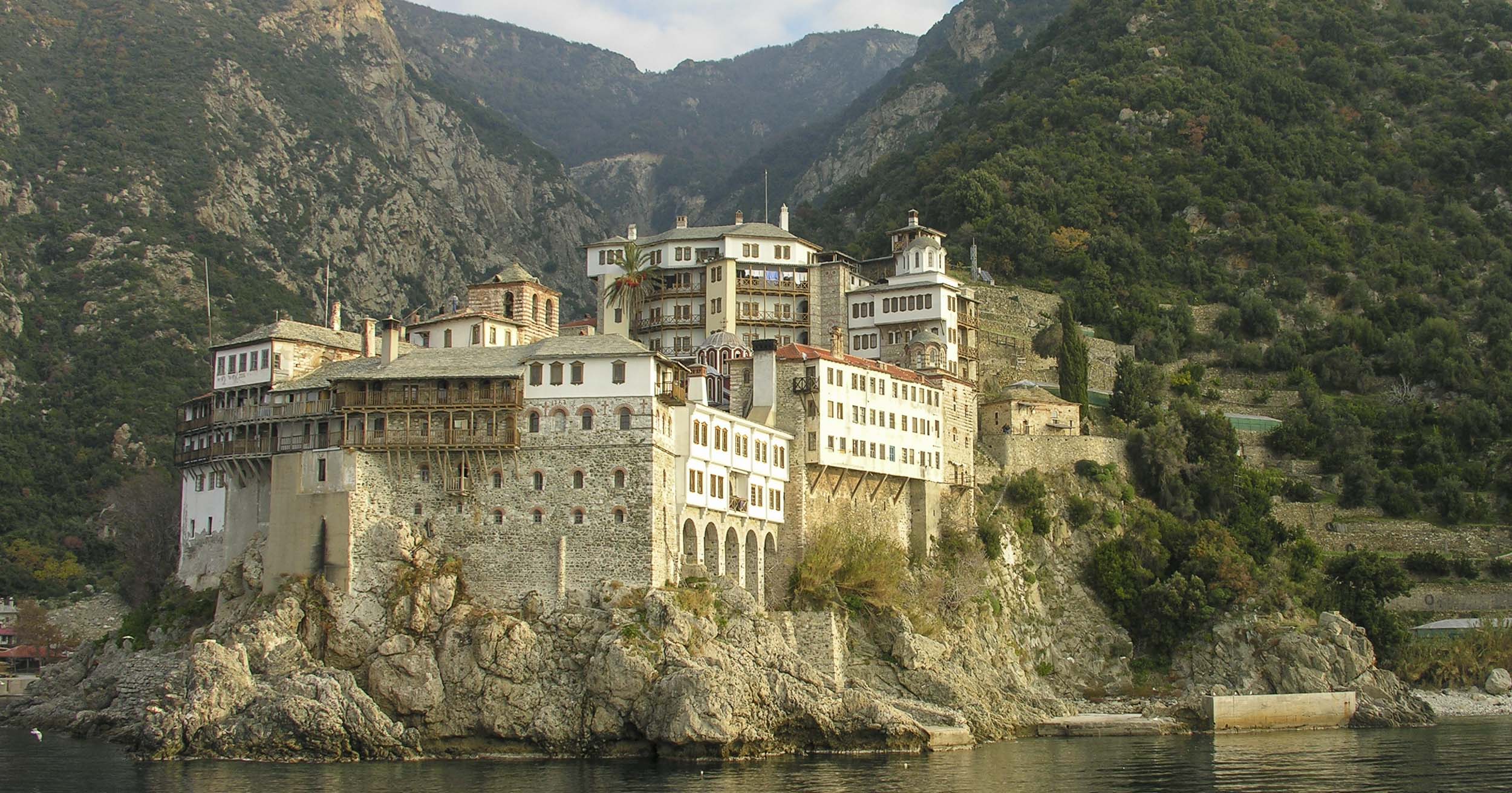
Everything in Halkidiki's long story culminates in its easternmost peninsula. Mount Athos - the Holy Mountain - is a self-governing monastic republic within Greece, home to twenty ruling monasteries and a tradition of organized monastic life stretching back over a thousand years. Its rule of avaton bars women from entering, as it has for centuries; men may visit only as pilgrims with a limited permit arranged in advance. For everyone else, the approach is by sea: cruise boats from Ormos Panagias near Vourvourou and from Ouranoupoli run along the coast at a respectful distance, close enough for the great fortified monasteries - part castle, part cathedral - to fill your camera frame beneath the 2,033-metre marble peak.
Seen from Sarti's beach across the gulf, Athos floats on the horizon like a myth that never ended - which, in a sense, it is: a working Byzantine world visible from your sunbed. We cover permits, cruises and viewpoints in depth in our complete Mount Athos guide.
History here is best digested slowly, over a long table. After a day among giants and philosophers, come back to Sarti and join us at Lauer House - a family-run taverna doing what tavernas on this coast have always done, with fresh seafood, slow-braised goat shank and the day's stories, daily from 10:00 to 24:00 in season. You can read our own small piece of Sarti history while you wait for dessert.